【IC-DLI Webinar II】From the winners of "Deep Life Paper” and "SiYuan-Ocean Emerging Leader" Awards in 2024
Join Zoom Meeting
https://us06web.zoom.us/j/85342193531?pwd=xwtcves1DyhE8oB3zDK0wPaOrYqWj1.1
Passcode: 904477
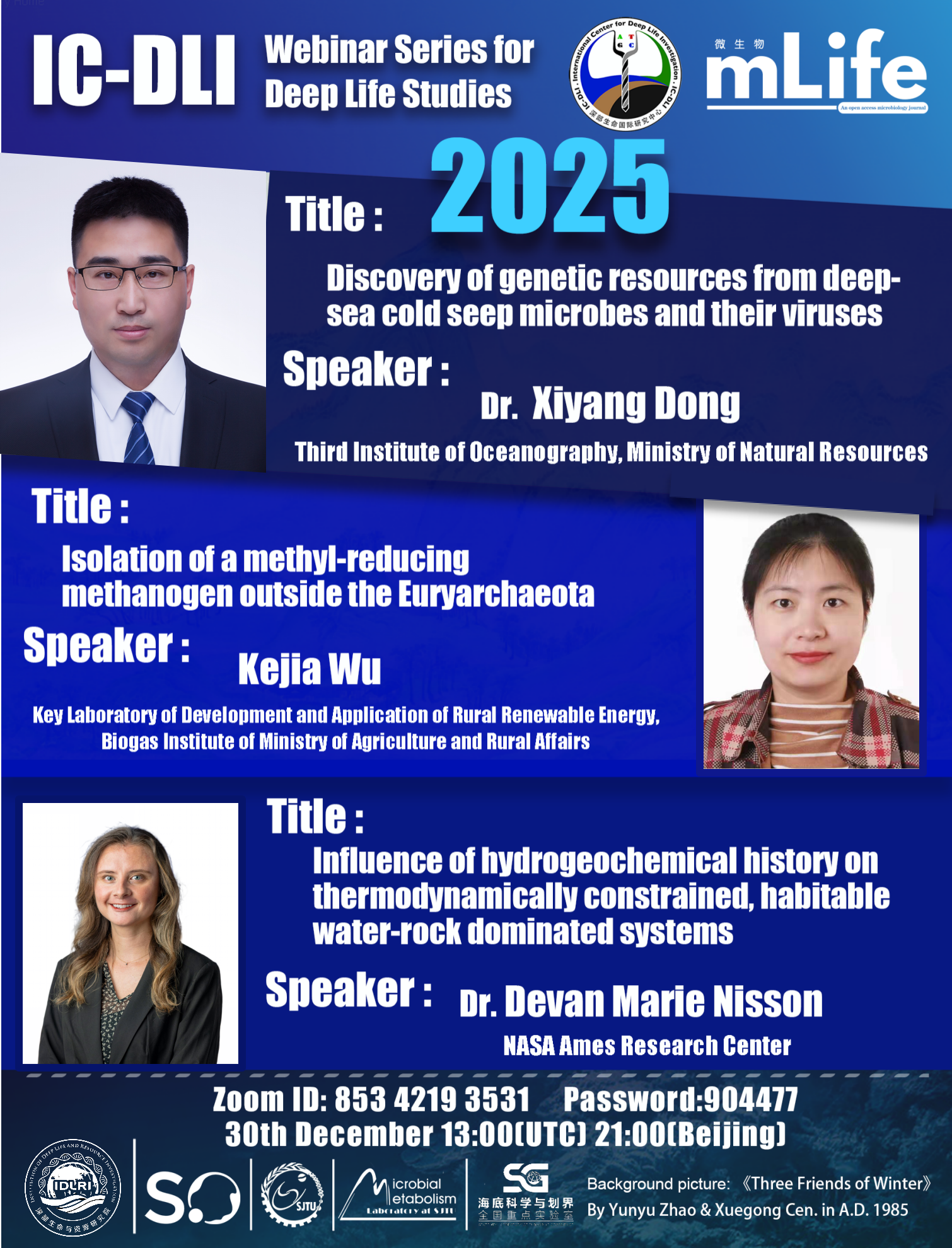
Title: Discovery of genetic resources from deep-sea cold seep microbes and their viruses
Speaker: Dr. Xiyang Dong, Third Institute of Oceanography, Ministry of Natural Resources
Abstract: Cold seeps are unique deep-sea ecosystems fueled by chemical energy and represent important natural windows into subsurface life. In this lecture, I will present our recent efforts to uncover genetic resources from cold seep microbes and their viruses. First, I will introduce our award-winning work revealing an extensive and highly novel repertoire of biosynthetic gene clusters, highlighting the hidden potential of secondary metabolism in cold seep sediments and its links to key biogeochemical processes. Second, I will present our latest findings on the global cold seep virome, uncovering vast viral dark matter, archaeal virus dominance, and diverse viral functions with promising biotechnological potential.
Titile: Isolation of a methyl-reducing methanogen outside the Euryarchaeota
Speaker: Kejia Wu, Biogas Institute of Ministry of Agriculture and Rural Affairs
Abstract: Methanogenic archaea are main contributors to methane emissions, and have a crucial role in carbon cycling and global warming. Until recently, methanogens were confined to Euryarchaeota, but metagenomic studies revealed the presence of genes encoding the methyl coenzyme M reductase complex in other archaeal clades1–4, thereby opening up the premise that methanogenesis is taxonomically more widespread. Nevertheless, laboratory cultivation of these non-euryarchaeal methanogens was lacking to corroborate their potential methanogenic ability and physiology. Here we report the isolation of a thermophilic archaeon LWZ-6 from an oil field. This archaeon belongs to the class Methanosuratincolia (originally affiliated with ‘Candidatus Verstraetearchaeota’) in the phylum Thermoproteota. Methanosuratincola petrocarbonis LWZ-6 is a strict hydrogen-dependent methylotrophic methanogen. Although previous metagenomic studies speculated on the fermentative potential of Methanosuratincolia members, strain LWZ-6 does not ferment sugars, peptides or amino acids. Its energy metabolism is linked only to methanogenesis, with methanol and monomethylamine as electron acceptors and hydrogen as an electron donor. Comparative (meta)genome analysis confirmed that hydrogen-dependent methylotrophic methanogenesis is a widespread trait among Methanosuratincolia. Our findings confirm that the diversity of methanogens expands beyond the classical Euryarchaeota and imply the importance of hydrogen-dependent methylotrophic methanogenesis in global methane emissions and carbon cycle.
Title: Influence of hydrogeochemical history on thermodynamically constrained, habitable water-rock dominated systems
Speaker: Dr. Devan Marie Nisson, NASA Ames Research Center
Abstract: In this talk, the hydrogeochemical history of terrestrial fluid environments and how geochemical processes in these systems contribute to microbial redox habitability, will be evaluated. Examples considered will include deep subsurface brines in Precambrian Shield (Moab Khotsong – Witwatersrand Basin, SA and Kidd Creek Mine – Ontario, CA) and evaporite (Boulby Mine – Whitby, UK) settings. Water-rock dominated systems of Precambrian shield sites tend to receive greater contribution from abiotic sources of dissolved organic carbon (DOC) and redox pools, relative to younger, evaporitic brines that are more biotically driven. While all these deep brines reveal similar thermodynamic constraints and similar (low biomass) metabolic populations, they do not share much taxonomic overlap. Regional geochemistry and long subsurface isolation exert a significant influence on microbial community composition alongside external abiotic stress.